Most businesses don’t start by thinking deeply about custom software or SaaS until it is too late.
In the beginning, the focus is usually somewhere else. Getting customers, setting things up, and figuring out how things should run. Software just becomes something you pick along the way.
You sign up for a tool. It works. That’s enough.
For a while, there is no reason to question it. Then things grow a little. Not drastically, just enough to notice small changes. More people are using the system. Slightly different ways of working. A few extra steps added here and there.
Nothing breaks. But something feels… slightly off. That is usually where this question begins to come up. Not suddenly. More like a thought that keeps returning.
Why this choice doesn’t feel important at first
At an early stage, most tools do what they are supposed to do.
You need to track leads, so you pick a CRM. You need invoices, so you choose an accounting tool. Everything is already available.
That is what SaaS is designed for. It removes the need to build anything yourself. You log in, use it, and move on.
There is no waiting, no technical planning, no complexity to think about. For small teams, that simplicity is not just convenient. It is necessary.
What SaaS actually looks like in daily work
Most people don’t think of it as SaaS while using it. It is just “the tool.”
Something you open in a browser. Something that works the same way every day. It has its own structure, its own way of doing things. You adjust a little, but not too much.
And in the beginning, it feels fine. Because your needs are still close to what the tool was designed for.
That is why SaaS works well for so many businesses early on.
The shift is not sudden; it builds slowly
Problems with SaaS don’t appear all at once. It is not like one day the system stops working. Instead, small gaps begin to show up.
A feature you wish existed. A process that takes longer than it should. A workaround that becomes part of daily work.
At first, these things feel manageable. You adjust. The team adjusts. Everyone finds a way around it. But over time, those small adjustments start stacking up.
When work starts bending around the tool
This is usually the point where things start to feel different. Instead of the software supporting the way you work, the work starts changing to fit the software.
It is subtle at first. A step was added here. A manual entry there. A small duplication that no one questions. But slowly, the workflow becomes less natural. Not broken. Just inefficient in ways that are hard to notice immediately.
That is where custom software enters the conversation
Custom software doesn’t appear because businesses want something new. It usually comes up because they want something that fits better.
Instead of adjusting the process, the idea is to build something around it. That sounds simple, but it changes a lot.
Because now the system reflects how the business actually works, not how a general tool expects it to work.
It is less about features and more about control
People often compare SaaS and custom software based on features. But features are not the main difference.
Control is. With SaaS, the structure is already defined. You can customize parts of it, but not everything. With custom software, that structure is created from scratch.
This means changes can be made when needed, not when the provider decides to update something.
Cost depends on how you look at it
In the beginning, SaaS is easier to justify. You pay monthly. There is no high upfront cost. It feels manageable. Custom software feels heavier at the start. It takes time, planning, and investment. But over time, the perspective shifts. Subscriptions continue. Teams grow. More tools get added.
What feels small monthly can become significant over a few years. Custom software has its own costs, but they behave differently. So the question becomes less about “cheap or expensive” and more about “when.”
Integration is where things quietly get complicated
Most businesses don’t rely on just one system. They use multiple tools that need to work together. SaaS tools offer integrations, but they are limited to predefined connections. If something falls outside that, it becomes harder.
Manual work starts appearing. Data gets copied between systems. Custom software avoids some of this because it can be designed to connect systems directly. Not perfectly every time, but more closely aligned to actual needs.
Speed feels important until it isn’t
SaaS is quick. That is one of its biggest strengths.
You can start using it almost immediately. Custom software takes time. There is planning involved, development cycles, and testing.
This is why most businesses begin with SaaS. But over time, speed becomes less important than fit. Once the business is running, the focus shifts from starting quickly to running smoothly.
Data becomes more important later
At the beginning, data is just information.
Later, it becomes something more valuable. With SaaS, data is stored within the provider’s system. It is secure, but control is shared.
With custom software, control is more direct. For some businesses, this matters a lot. For others, not as much.It depends on what the data represents.
Most businesses don’t fully switch
In reality, very few businesses move completely from SaaS to custom software.
They combine both. SaaS for general tasks. Custom systems for specific workflows.
This balance works because not everything needs to be built from scratch. And not everything fits into a ready-made tool either.
How TMITS usually looks at this
At TMITS, the decision is not treated as one direction or the other.
It starts with understanding how the business operates. If SaaS is working, there is no reason to replace it.
If it starts creating friction, then custom software becomes part of the discussion. It is not about replacing tools. It is about improving how things function.
When Teams Start Feeling The Friction Internally
A major clue for figuring out if something isn't fitting right can be how humans interact with each other and their environment, not just the technology itself. If people are doing tasks that should only take a few minutes and they are starting to notice delays in getting things accomplished, then there is a clue that they are being impacted by "human" factors. They are beginning to notice delays in getting everyday tasks done.
While the delays might not appear serious enough initially to warrant ceasing operations altogether, if the problem persists over an extended period of time, the total number of hours spent with no meaningful progress will add up. If this type of situation continues for three to six weeks or beyond, a pattern will most likely begin to develop.
Some teams may not be vocal about their frustrations or concerns; they may simply work together on their project as if nothing has occurred.
Other teams may become increasingly vocal about their frustrations and concerns when conversing with their fellow coworkers, as well as through other methods of communication. As such, people will begin to notice and recognize that certain patterns exist before there is an apparent explanation for them.
The main reason for this friction has nothing to do with effort or skill level; it has more to do with how systems are designed versus how people actually do their work.
When software does not provide complete support to processes, then teams fill in the blanks manually. This is a very real and prevalent difference between SaaS and custom software in your day-to-day environment.
Growth Brings Questions That Tools Cannot Always Answer
As a company expands and grows, the nature and types of questions that must be answered are evolving. Initially, basic reports and relatively straightforward dashboards will suffice for the business owner.
You will only need to know a general sense of the overall performance of your company.
Eventually, your questions will become much more detailed, and you will want to begin analyzing trends, assessing performance across many levels, and connecting data from multiple domain areas.
At this point, challenges to these analyses will arise. For example, several Software as a Service (SaaS) solutions provide pre-built reporting functionality that is limited to pre-defined structures; therefore.
If your question cannot be answered by existing reports and is not within the established structures, it will be very challenging or impossible to extract.
Alternatively, custom software solutions allow reporting data to be constructed around the specific needs of the organization and can bring together data from many different platforms and present this information in meaningful formats to assist any management-level data-driven decision-making process.
This change will not always happen immediately, but the longer the delay between the need for change and implementation, the longer it will be before businesses re-evaluate their existing systems.
A simpler way to look at it
In most cases, if an organization's operating procedures remain basic and uniform, you should be able to accomplish all of your objectives utilizing Software as a Service (SaaS) solutions.
However, if an organization's business processes are rapidly evolving and the business continues changing its methods to adapt to the various tools available, other options can be explored. This does not imply that the SaaS application failed; it simply indicates that the organization has exceeded the limitations of the application.
Contact TMITS to see how we can fast-track your journey towards growth.
FAQs
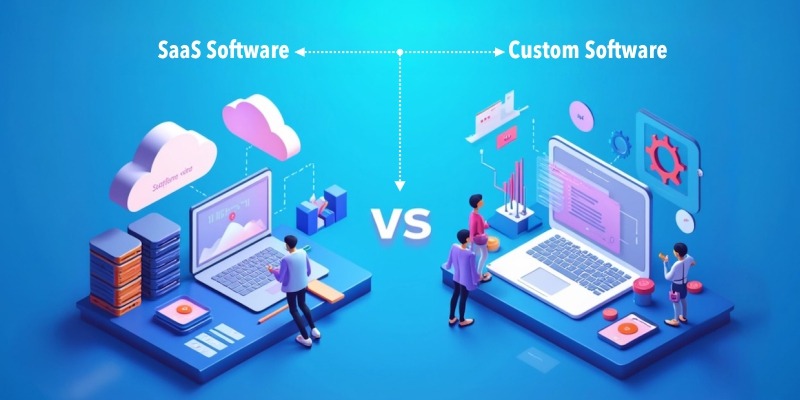
1 What is the difference between SaaS and custom software
SaaS is ready-made software used through subscription, while custom software is built specifically for how a business operates.
2 Is SaaS better for startups
Yes, in most cases, it helps startups move quickly without needing development resources.
3 When does custom software make sense
It usually makes sense when workflows become complex and existing tools start limiting efficiency.
4 Can both be used together
Yes, many businesses use SaaS for general needs and custom software for specific processes.
5 Is custom software expensive
It requires upfront investment, but long-term costs depend on how it is used and maintained.