
Predictive & Language Models Services
You have data and language tools, but the question is what should happen next, and Predictive & Language Models combine forecasting and language understanding to turn data into real-time decisions.
Measurable outcomes
What you get
- 30–60% faster decisions
- 20–40% better forecast accuracy
- 25–50% less manual analysis
You Have Data. But You Don't Have Intelligence Working Inside It
Dashboards are updating. Reports are being generated. Content is being produced.
But decisions still depend on human interpretation. Marketing still waits for analysis. Sales still react instead of anticipating. The real issue isn't a lack of data.
It's the absence of systems that can predict behaviour before it happens, understand language at scale, and trigger action without waiting for manual decisions. Most businesses are sitting on intelligence they are not using.
That's where Predictive & Language Models change the system.
Right now, insights sit inside tools instead of turning into action. Teams spend more time interpreting dashboards than responding to what is already forming in the data. Customer behaviour, conversations, and transactions already carry signals, but they are scattered and slow to act on.
Generative AI adds another layer by turning raw inputs like queries, feedback, and documents into usable outputs in real time. Combined with predictive systems, it doesn't just explain what happened, it helps generate responses, actions, and decisions instantly.
This reduces delay between insight and execution, allowing businesses to move from reporting to anticipating, and from reacting to actively shaping outcomes as they unfold across the system.
Signal flow
Where signals get lost
50%
Manual
hrs
Lag
40%
Blind spots
Lost at: Predicted → Interpreted
−62%What's Actually Happening Inside Your Business Right Now
Most companies we work with are not broken. They are just not predictive or language-aware at scale. Here's what we usually see:
You can see activity everywhere. But you cannot see what it means next. That delay is where revenue, time, and opportunity are lost.
What Predictive & Language Models Actually Do
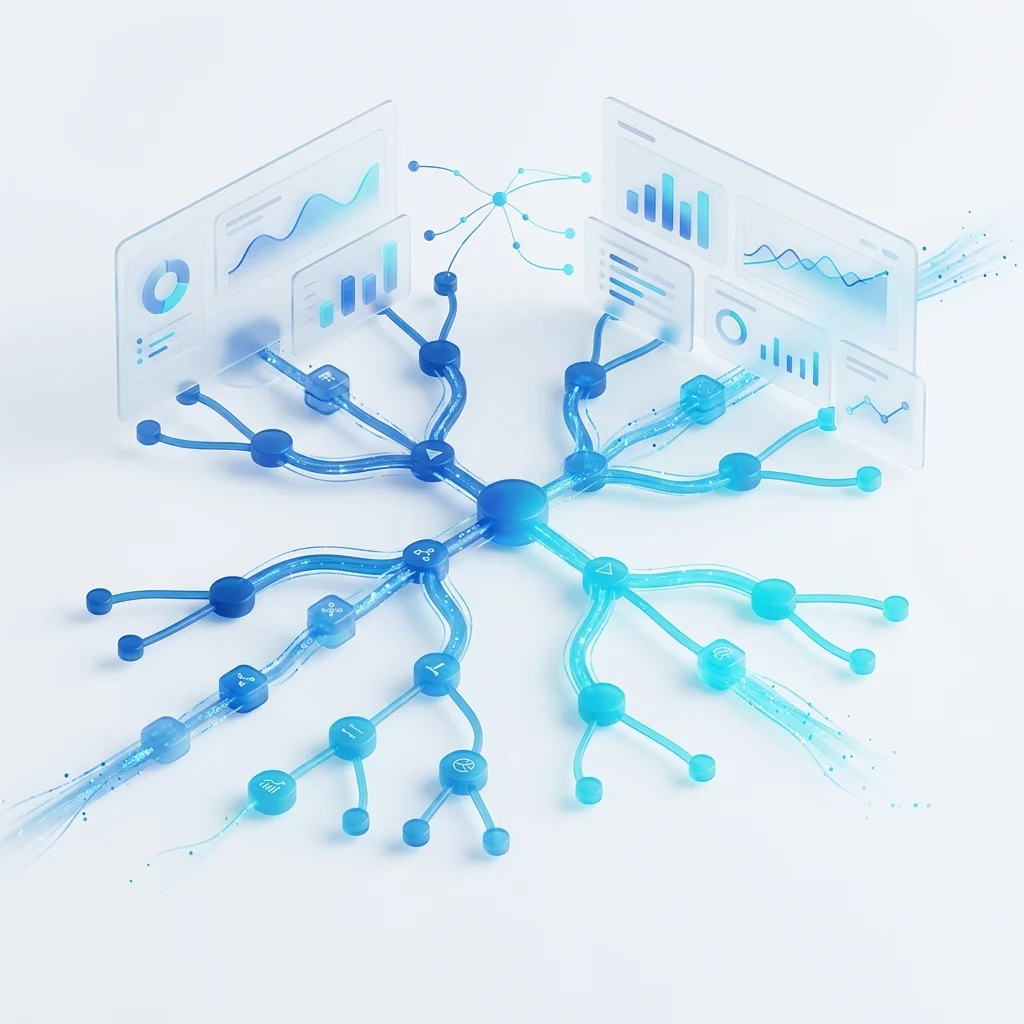
We combine two intelligence layers and run them as one loop.
Predictive Models (Forecasting Intelligence) analyse patterns in your business data to forecast outcomes such as future customer behaviour, conversion probability, churn risk, revenue trends, demand fluctuations, and lead scoring accuracy. Instead of asking what happened, you start knowing what will happen next.
Language Models (Context & Communication Intelligence) understand and generate human language at scale. They interpret customer messages, automate responses and support flows, summarise business data into decisions, generate content aligned with user intent, support enterprise LLM solutions, and extract meaning from unstructured text such as emails, chats, and reviews. Instead of manually reading everything, the system understands it for you.
Forecast
Predicted vs actual
Churn risk rising for 3 accounts — recommend outreach this week.
How We Combine Both
Most systems use either prediction OR language. We combine them:
This creates a continuous loop: data → prediction → interpretation → action. This is where business intelligence becomes execution intelligence. Custom or fine-tuned models are trained or adapted to your business patterns - they are not 'better AI', they are aligned AI.
How We Structure Predictive & Language Model Systems
Understand how intelligence is currently used
We start by mapping how information is currently processed inside your business.
- We start by mapping how information is currently processed inside your business.
- Most teams already use dashboards, reports, and generative AI tools, but they are often disconnected from the actual decision flow.
- We study where data enters, how it is interpreted, and where human judgment is still required.
- This includes marketing, sales, customer support, operations, and product usage.
- We identify how insights are currently generated, how long it takes to act on them, and where information gets lost between systems and people.
- This gives a clear baseline of where intelligence is underused or delayed.
Connect predictions to real business outcomes
Most businesses have data models, but they are not tied directly to measurable outcomes.
- Most businesses have data models, but they are not tied directly to measurable outcomes.
- So we connect predictive outputs to real performance indicators.
- We link predictions to churn risk, purchase probability, lead quality, revenue movement, and customer engagement patterns.
- This helps clearly define which signals actually matter and which ones are just noise.
- This step ensures predictive systems are not theoretical, but directly connected to business performance and measurable impact.
Build language understanding and AI layer
Once prediction pathways are clear, we build the language intelligence layer that makes data usable in real time.
- Once prediction pathways are clear, we build the language intelligence layer that makes data usable in real time.
- This includes connecting generative AI systems to customer conversations, CRM notes, support tickets, product feedback, and internal documentation.
- The goal is simple: convert unstructured information into structured meaning that can be used instantly.
- Instead of manually reading or summarising data, the system understands context and generates usable outputs across teams.
Merge prediction and AI into action systems
This is where both systems operate together as one intelligence layer.
- This is where both systems operate together as one intelligence layer.
- Predictive models identify what is likely to happen next, while contextual outputs turn those signals into clear, human-readable meaning.
- Together, they convert raw data into actions the system can actually use in real time:
- Lead prioritisation based on conversion probability
- Customer response generation using real-time context
- Risk alerts for revenue or operational changes
- Personalised messaging driven by user behaviour
- Automated triggers based on defined system thresholds
Over time, this reduces dependency on manual interpretation and allows decisions to happen closer to the moment data is created, not after it is analysed.
What Changes When the System Is Fully Integrated
When predictive and language models are properly integrated:
The outcome is not 'AI in your business'. It is a business that understands itself before reacting.
How Performance Changes with Predictive Systems
Data mapping
Data mapping reveals where decisions are currently delayed or broken.
First signals go live
First predictive signals and language workflows go live. Teams start seeing early pattern visibility.
Manual work reduces
Systems begin reducing manual decision-making. Forecast accuracy improves. Language automation starts handling repetitive workflows.
The system becomes self-improving
The system becomes self-improving as more data flows in. Predictions and language outputs become more aligned with actual business outcomes.
Related case studies
Questions, answered
Related capabilities
Build a System That Thinks, Predicts, and Responds
If your business already has data but decisions still feel slow, unclear, or reactive, this is where it changes. We map your systems, identify prediction opportunities, and design how predictive + language models can work inside your operations.
No templates. No generic AI setup. Just a clear system showing how your business can think, predict, and respond in real time.