Your infrastructure is either accelerating your business or silently holding it back.
Companies are investing in AI, analytics, and digital expansion, yet many still rely on infrastructure built for a different era. However, they are also running on an IT infrastructure that has not been changed in ten years.
The result? Rising maintenance costs, limited scalability, and increasing operational risk are hiding beneath the surface.
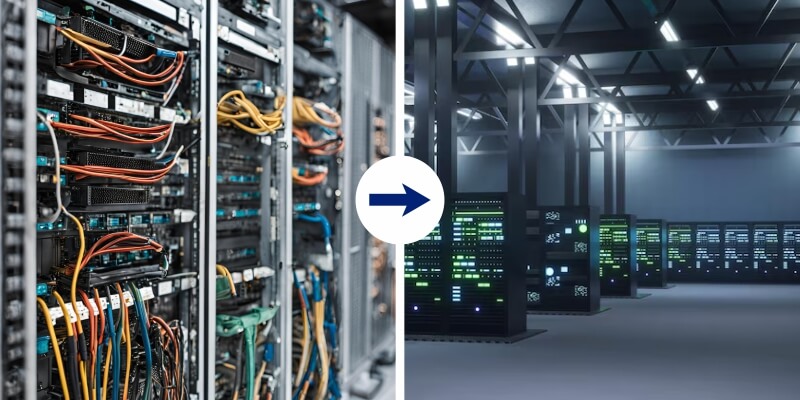
Legacy infrastructure can still be functional, but it was never designed for today’s speed, security, or growth aspirations. The real competitive advantage doesn’t come from patching old systems, but by enabling a strong, hybrid architecture for what’s next.
Understanding the True Cost Curve: Maintenance vs Modernization
The Financial Realities of Maintaining Legacy Infrastructure
On a surface level, it may seem sensible from a financial perspective to simply maintain your existing systems, provided they "still work." But there can be hidden costs, operational, support, and risk-related costs, which accumulate annually.
- Legacy infrastructure has a never ending requirement for maintenance, patching, and vendor support. While aging hardware and software increase costs and require specialized talent.
- IT teams spend more time troubleshooting legacy systems, limiting innovation, and slowing IT modernization initiatives.
- Legacy systems without the support of vendors can carry serious security and compliance risks that raise operational and regulatory costs.
It has also been stated that, according to Gartner, maintenance costs can escalate by 15-25% annually, while the value of systems declines, thereby converting debt into a financial burden.
Modern Hybrid Systems Flip the Curve
In modern systems, particularly hybrid systems, you can actually shift your model from undeterminate maintenance to strategic value creation:
- Scalable hybrid infrastructures, such as hybrid cloud platforms, enable efficient optimization by ensuring proper alignment of expenses with usage patterns to minimize overspending.
- While automated features of updates, monitoring, and allocation might lead to a decrease in system downtime, resulting in a reduction in operational labor costs.
- Hybrid systems ensure that critical legacy workloads remain on premises while ensuring cloud elasticity for growth, scalability, and peak demand.
This isn’t just spending more - it’s spending smarter to reduce the total cost of ownership (TCO) over time.
Downtime Risk and Scalability Limits: How Legacy Holds You Back
Why Downtime Is More Expensive Than You Think
Legacy hardware and software fail, and when they do, the consequences are wide for business: lost productivity, missed SLAs, and erosion of customer trust.
IDC and industry reports highlight:
- Unsupported legacy systems have a higher possibility of system outages due to unaddressed vulnerabilities and outdated hardware failures.
- Every hour of enterprise downtime can result in substantial amounts, depending on workload, industry, and operational scale.
Modern hybrid environments feature redundancy, automated failover, and high-availability architectures, minimizing downtime and enhancing reliability.
Scalability Isn’t Optional - It’s a Business Imperative
Businesses grow, and workloads must scale accordingly:
- Legacy systems often tend to lack modularity, and scaling legacy systems may require high capital cost, leading to over-provisioned but underutilized resources.
- With cloud elasticity, as in modern hybrid infrastructures, any spike or seasonal loads are instantly satisfied, whereas core workloads remain on-premises and are cost-effective in terms of performance.
This scalability is especially critical for distributed enterprises, real-time processing, data analytics, and customer-facing applications.
When Hybrid Infrastructure Is the Right Move
You shouldn’t modernize everything all at once; that’s neither practical nor cost-effective. The hybrid infrastructure model is a balanced approach, helping organizations transform without risking destabilizing core infrastructure and operations.
Best Scenarios for Hybrid Adoption:
- When critical legacy workloads still operate reliably but restrict scalability or performance
- When there are unforeseen or seasonal peaks in demand due to business growth
- When there are regulatory frameworks in place regarding certain data being present on-premises
- Maintaining business continuity essential during infrastructure transformation.
Well-designed hybrid IT infrastructure empowers organizations to protect existing investments while bringing in cloud agility, where it will deliver the most value. Controlled modernization is what ensues, marrying on-premises stability with scalable, cloud-driven flexibility.
A Practical Path to Modernization - Without Fear
IT modernization is not necessarily the risky strategy of an overhaul. A phased, risk-aware approach ensures stability, measurable ROI, and controlled transformation.
- Assess Your Existing Infrastructure: Evaluate your existing infrastructure to identify technologies with high maintenance and risk factors. Prioritize modernization efforts with impact on businesses and cost efficiency.
- Pilot the Hybrid Model: First, non-critical workloads should be ported to test scalability and compatibility within a hybrid infrastructure.
- Scale Strategically: Hybrid implementations should be extended to mission-critical applications after benchmarks on stability and security have been met.
- Optimize Continuously: Utilize automation and analytics to enhance performance, reduce cost, and optimize resource utilization.
This approach also avoids the disruptive tendency towards "rip and replace" and provides modernization with visibility, control, and scalability.
Why This Matters for Your Business
Decision-makers who delay modernization aren't just keeping old hardware but also bet against agility, resilience, and competitive edge.
Legacy systems may still "work," but they often:
- Improve operational costs
- Divert IT talent into maintenance work
- Increase risk regarding downtime
- Limit scalability and growth
Modern hybrid infrastructure offers you a future-ready foundation that promotes innovation, mitigates risk, and provides your organization with growth prospects for the digital world.
Ready to Modernize Safely?
Modernization doesn’t have to mean uncertainty, disruption, or unnecessary risk. With the right strategy and execution partner, it becomes a controlled, measurable transformation aligned with your business goals.
Modernize safely with TMITS IT infrastructure modernization services. We will help you to build scalable, reliable, and cost-effective IT infrastructure, while ensuring there are no disruptions to your existing IT activities.
Whether you are adopting a new hybrid infrastructure model, optimizing existing workloads on legacy platforms, delivering higher availability solutions, or embarking on a phased enterprise-wide migration. TMITS is dedicated to providing structured assessment, migration frameworks, and engineering expertise.
The goal isn’t just upgrading systems. It’s building an infrastructure foundation upon which your business strengthens performance, risk is minimized, and is geared to support any growth after digital.
Let’s modernize - strategically, securely, and with confidence.
Frequently Asked Questions
How can Indian enterprises migrate from legacy infrastructure to hybrid cloud environments?
In the case where an Indian business is involved, it could use a strategy like phased migration. It could do so by looking at high-maintenance systems, prioritizing workloads, and then deploying non-critical applications in a hybrid approach.
What are the cost benefits of adopting hybrid systems over legacy infrastructure for IT operations?
Hybrid systems reduce the operational expenses over a period by mapping IT expenses to actual usage, hence cutting down on over-provisioning, which reduces costs. They also decrease downtime risk and raise efficiency, thereby improving the Total Cost of Ownership (TCO).
How do modern hybrid systems enhance scalability and flexibility compared to monolithic legacy architecture?
Modern hybrid computing systems take full advantage of cloud elasticity to scale resources on demand instantly. Unlike monolithic legacy architecture, hybrid infrastructure, which allows modular expansion, workload distribution, and performance optimization without large capital expenditure.
What are the key differences between legacy infrastructure and modern hybrid IT systems?
Legacy infrastructure is bound to hardware, less scalable, and intensive in maintenance. The modern hybrid IT system integrates on-premises control with cloud flexibility. This encourages better scalability, automation, redundancy, and economies of scale.
When is the right time for an enterprise to modernize legacy IT infrastructure?
The right time to modernize is the time your maintenance costs go up, your scalability problems become limited, your risk of downtime goes up, and your digital growth initiatives are constrained.